My Favourites (
 My Kiwicare
 Email
Email  Print
Print Winged Ants - Should You Be Worried?
Are you seeing a large number of insects that look like ants with wings flying around? You’d better get onto treating the problem quickly. These are regular ants that are mating and looking to set up a new colony to lay their eggs.
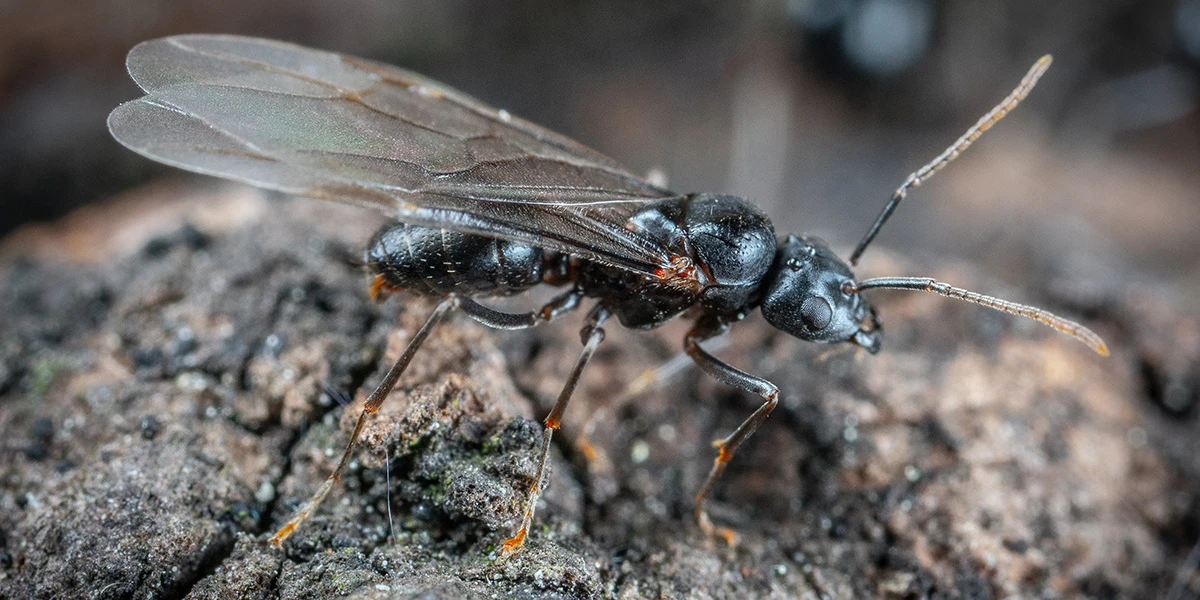
Often referred to as flying ants or alates, ants with wings are the female queen and male ants who grow wings, take to the air for a nuptial flight to reproduce and start new colonies. This happens in the form of swarms that can be of significant numbers.
Ants normally swarm in warmer summer months but if nests are indoors or in warm locations swarming can occur in autumn and into winter.
Nuptials / Mating Flight for Ants
- Flying ants are ants mating (not all species mate in this way).
- Queens and males mate in flight.
- After mating males die and queens fly to seek a new nest site (not usually more than 100 metres from the original nest).
- Queens land at a suitable nest site and lose their wings.
- They then found a new colony.
- Flying ants annoy people as there can be many thousands.
Possible Nest Sites
- Dry places – heavy rain could drown nests.
- Warm – insects are more active when warm, ants prefer warm locations.
- Sunny – radiant heat can make ground and ants warm even on days with cool air temp – it is a micro-climate.
- Sandy soil – sandy soils make it easy to dig out nest chambers and well-draining soils are less likely to be drowned out.
- E.g. under concrete paths, under driveways, under rocks, under or in pots, etc.
- Ants sometimes nest in buildings, but if so, it is probably in exterior wall or eaves on the sunny side of the house.
How to treat the Ant problem
Indoors
If the ants are indoors the use of NO Bugs Super Bug Bombs can effectively knock the ants down and prevent new colonies being formed.
Outdoors
To prevent infestations, it is advisable to treat possible nest sites in the area with NO Ants Ant Sand or LawnPro Protect. Note: only use NO Ants Ant Sand on existing nests.
Stop ants from getting access to their nests: Repair cracks in concrete, paths, walls, etc. Apply NO Ants Ant Sand to cracks and edges of paths. Apply LawnPro Protect to soil areas (particularly flowerbeds and lawns close to the house) water in.
Stop ants getting in: spray the base of walls, doorways, windows and around vents, where pipes/cables etc. run through walls with NO Ants Barrier Spray or NO Bugs Super.
Identification: It is often difficult to identify the ant species from the winged males and queens as they are often very different to the worker ants that are usually seen. You might be used to seeing small ants in the garden or house and then find winged ants that are much larger and look different; they could be the males and queens of the same species.
Winged ants can be mistaken for winged termites. Termites, sometimes known as white ants are usually hidden away inside wood and it only the winged aletes during their mating nuptial flight that they are seen. Good ways to tell them apart is that termite wings are twice as long as the body and ants have distinct narrowing between thorax and abdomen.